
Foodstagramming: The World's Most Delicious Marketing Strategy.
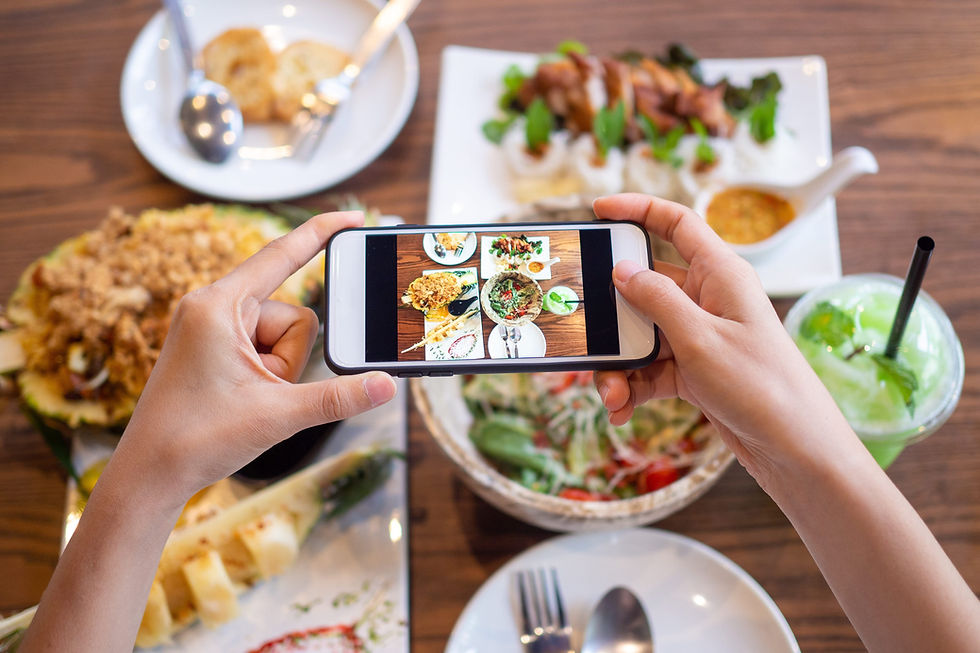
"Wait... don't touch it yet." It's a sentence almost everyone has heard around a dinner table. The food arrives. Nobody reaches for their fork. Instead, phones appear almost instinctively. Someone rotates the plate toward the window. Another adjusts the drink. A friend says, "Take it from above." For a few seconds, dinner stops! Not because the food isn't ready, but because the photo isn't.
What's remarkable is that we rarely question this behaviour anymore. It's become automatic.
Psychologists call these learned digital habits: actions repeated so often they become almost subconscious. For many of us, photographing food no longer feels like making a decision. It feels like part of the dining experience itself. Researchers studying "foodstagramming" found that many diners described photographing their meals as an "automatic reaction" before taking the first bite.

And marketers should be paying attention. Because food may be the most successful form of visual marketing ever created, not by brands, but by people.
Think about it. We don't usually photograph our laptops before opening them. We don't stop to admire our groceries. We rarely document everyday objects with the same enthusiasm. Yet place a beautifully plated brunch, colourful dessert or perfectly poured latte in front of us, and something changes. We instinctively reach for our phones.
Not because someone asked us to. Because we want to. That's marketing at its most powerful.
In fact, food and drink remain one of Instagram's biggest interest categories, with hundreds of millions of posts carrying the #food hashtag. More telling is how people behave around those posts. Surveys have found that 59% of people have stopped someone from eating so they could take a photo first, 57% have rearranged their meal to make it more photogenic, and 44% regularly share photos of their meals on social media. Even more surprising, 40% admitted posting photos of food they never intended to eat.

When millions of people voluntarily become photographers, stylists and publishers for the same subject, it stops being a trend. It becomes culture. So why does food work so well? Because food is never just food.
Every image carries a story. A first date. A birthday dinner. A Sunday brunch after a long week. Street food discovered while travelling. Grandma's recipe. The café everyone has been talking about. We aren't simply sharing what we ordered, we're sharing where we were, who we were with and how the moment made us feel.
The plate becomes the memory. That's exactly what great marketing does. People rarely remember every feature of a product, but they remember how it made them feel. The most successful brands don't sell objects; they sell experiences, identity and emotion. Food photography happens to capture all three in a single frame.

There's another reason these images perform so well online. Food is universally understood.
You don't need to speak the same language to appreciate a flaky croissant, a steaming bowl of ramen or a perfectly grilled burger. Colour, texture, movement and anticipation communicate instantly. Before our brains process the caption, the image has already done its job.
That's why restaurants today don't just invest in chefs. They invest in presentation, lighting, interiors and plating. They're designing meals that customers want to photograph because every shared image becomes authentic word-of-mouth marketing. Increasingly, younger diners discover new restaurants through Instagram, TikTok and creator content before they ever search Google or read a review.
A 2026 survey found that 73% of Gen Z and Millennials visited a restaurant after seeing it on social media, with many relying on visual content as their primary discovery tool. In other words, the customer has become the media channel.

Perhaps that's the biggest lesson for marketers. The most powerful content isn't always the content your brand creates. It's the content people feel compelled to create themselves. Every time someone pauses their meal to take a photo, they're answering a question every marketer asks: "Is this worth sharing?" If the answer is yes, you've already won half the battle.
Lately, though, I've noticed something in myself. I still reach for my phone when the food is exceptionally beautiful. Some habits are hard to break. But more often than not, I find myself putting it back down. Not because the meal isn't worth photographing, but because it's worth experiencing while it's still hot, while the conversation is still flowing, while the people around the table are laughing.
Maybe that's where food photography has quietly changed. It was never really about the food. It was about wanting to remember how that moment felt. And perhaps that's the simplest marketing lesson of all. People don't share what they consume. They share what they don't want to forget.


The article's point about foodstagramming as a visual marketing strategy raises a practical question for brands: how do you make a single food photo work across an entire profile? Beyond the usual filters and hashtags, the layout itself can shape engagement. For anyone experimenting with that, a free browser-based tool like Instagram grid maker can help split one image into 3x3 banners, swipeable panoramas, or feed tiles without uploading files to a server. It's not essential, but it's a useful option when you want to test how a cohesive visual grid affects a food-focused feed.
This is a great perspective on how food photography has evolved from a simple habit into a powerful form of user-generated marketing. The point about people sharing experiences and emotions rather than just products really stands out. Visual presentation clearly plays a major role in making an experience memorable and shareable. For events where visual presentation matters just as much, Stage Truss can help create professional and engaging stage setups.